Case No. 11 Architecture
A small modern house from the street
Boxes for the volumes, glass panes for the windows, cone-and-cylinder trees, overcast light.
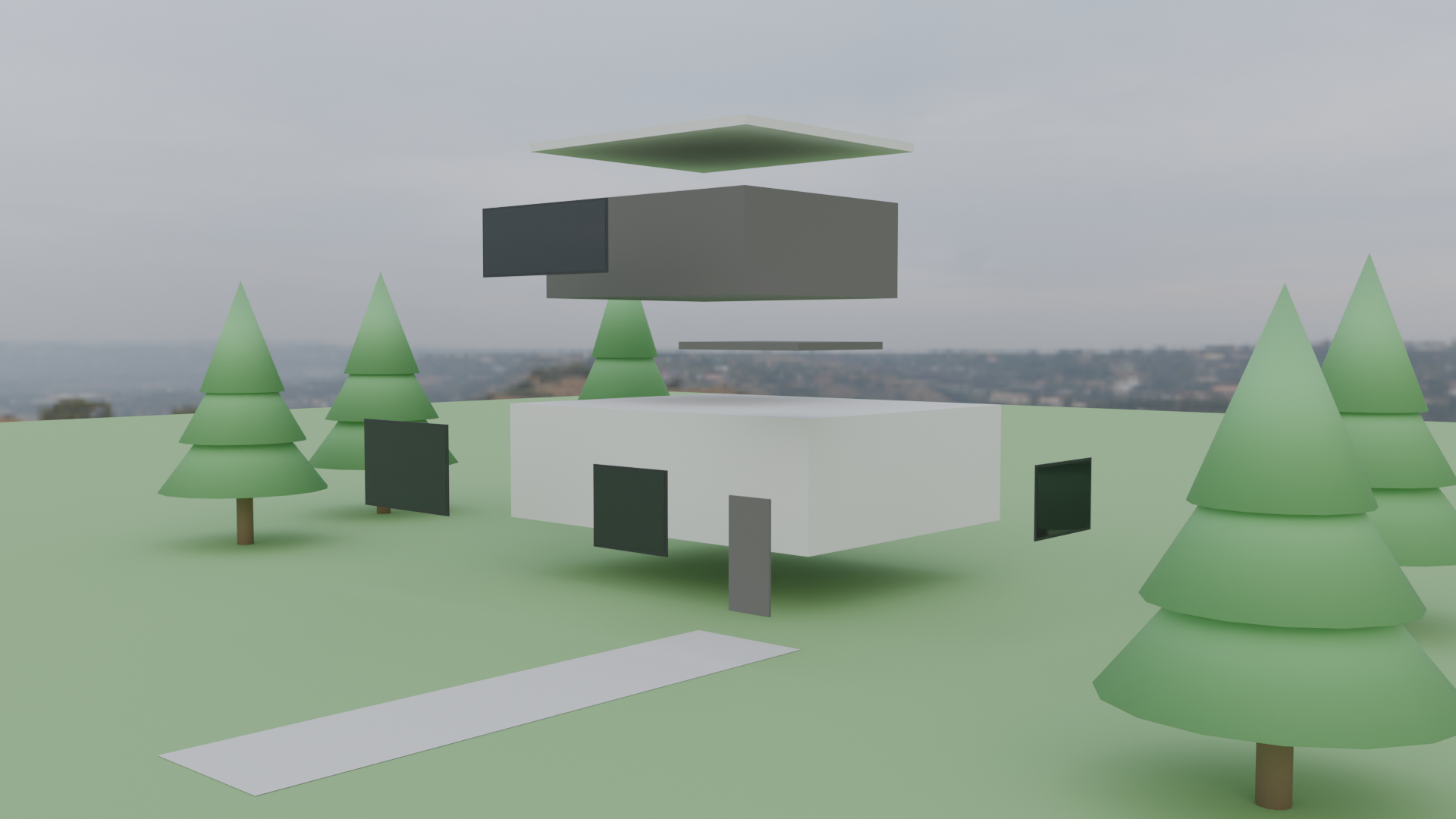
This architectural exterior of a small modern house was rendered on a JANCTION GPU from a primitives-only bpy script under the overcast preset. Volumes are boxes, windows are glass panes and the trees are cones on cylinders. It took 8.0 GPU seconds on the production GPU, 0.8 JPY at 0.1 JPY per GPU-second.
What is in the frame
A two-storey house with a cantilevered upper volume, large glazing and a lawn with stylised trees. It is a massing study, the stage where an architect wants to see proportions quickly.
How the scene is built
Every element is a primitive. The overcast preset lights the house evenly, which keeps the read on form and proportion rather than on dramatic shadow.
Adapt it
Change the volumes' dimensions in the script and render a series. For a different mood, the same call with environment="sunset" gives low warm light.
0.8 JPY for this render. The free welcome credit of a new key covers about 125 of them, with no card.
Render this example with your AI
ChatGPT · Claude · Grok · Perplexity
Use JANCTION Render (MCP server https://render.janction.jp/mcp) to render this example: render_preview(scene_url="https://render.janction.jp/samples/ex11_arch_exterior.py"). Then suggest how to change the colors, shapes and camera for my own subject. Ask me before the final render.
Each link opens the app with the text below filled in (if it is not, copy and paste it). If JANCTION Render is not connected in that app yet, add https://render.janction.jp/mcp as a connector first.
Blender warnings
- environment preset 'overcast' replaced the scene's world (HDRI lighting)
The script (bpy, runs as is)
ex11_arch_exterior.py. It builds the scene, the camera and the frame range; resolution, samples, denoising and the GPU are set by the service.
"""JANCTION Render example 11: a small modern house seen from the street (architectural exterior, one still).

Reproduce: render_final(scene_url="https://render.janction.jp/samples/ex11_arch_exterior.py",
                        width=1920, height=1080, samples=128, environment="overcast")
Boxes for the volumes, glass panes for the windows, cone-and-cylinder trees. The overcast preset lights it.
"""
import math
import random

import bpy
from mathutils import Vector

for ob in list(bpy.data.objects):
    bpy.data.objects.remove(ob, do_unlink=True)
scene = bpy.context.scene
scene.frame_start = 1
scene.frame_end = 1
scene.render.fps = 24
random.seed(11)


def material(name, color, roughness=0.5, metallic=0.0, **inputs):
    mat = bpy.data.materials.new(name)
    mat.use_nodes = True
    bsdf = mat.node_tree.nodes["Principled BSDF"]
    bsdf.inputs["Base Color"].default_value = (*color, 1.0)
    bsdf.inputs["Roughness"].default_value = roughness
    bsdf.inputs["Metallic"].default_value = metallic
    for key, value in inputs.items():
        bsdf.inputs[key].default_value = value
    return mat


def smooth(ob):
    for p in ob.data.polygons:
        p.use_smooth = True
    return ob


def add(op, name, mat=None, **kw):
    getattr(bpy.ops.mesh, op)(**kw)
    ob = bpy.context.object
    ob.name = name
    if mat is not None:
        ob.data.materials.append(mat)
    return ob


def text(body, name, mat, location, size=1.0, extrude=0.02, rotation=(math.pi / 2, 0, 0), align="CENTER"):
    cu = bpy.data.curves.new(name, type="FONT")
    cu.body = body
    cu.size = size
    cu.extrude = extrude
    cu.align_x = align
    ob = bpy.data.objects.new(name, cu)
    scene.collection.objects.link(ob)
    ob.location = location
    ob.rotation_euler = rotation
    ob.data.materials.append(mat)
    return ob


def look_at(ob, target):
    ob.rotation_euler = (Vector(target) - ob.location).to_track_quat("-Z", "Y").to_euler()


def camera(location, target, lens=50.0, name="Camera", active=True, fstop=None, focus=None):
    data = bpy.data.cameras.new(name)
    data.lens = lens
    if fstop is not None:
        data.dof.use_dof = True
        data.dof.aperture_fstop = fstop
        data.dof.focus_distance = focus if focus is not None else (Vector(target) - Vector(location)).length
    cam = bpy.data.objects.new(name, data)
    scene.collection.objects.link(cam)
    cam.location = location
    look_at(cam, target)
    if active:
        scene.camera = cam
    return cam


def light(name, kind, location, energy, target=None, size=1.0, color=(1.0, 1.0, 1.0)):
    data = bpy.data.lights.new(name, kind)
    data.energy = energy
    data.color = color
    if kind == "AREA":
        data.size = size
    ob = bpy.data.objects.new(name, data)
    scene.collection.objects.link(ob)
    ob.location = location
    if target is not None:
        look_at(ob, target)
    return ob


def world(color=(0.02, 0.02, 0.03), strength=1.0):
    w = bpy.data.worlds.new("World")
    w.use_nodes = True
    bg = w.node_tree.nodes["Background"]
    bg.inputs[0].default_value = (*color, 1.0)
    bg.inputs[1].default_value = strength
    scene.world = w
    return w

concrete = material("Concrete", (0.72, 0.7, 0.66), roughness=0.85)
dark = material("DarkCladding", (0.12, 0.11, 0.1), roughness=0.6)
glass = material("Glass", (0.8, 0.9, 0.95), roughness=0.05, **{"Transmission Weight": 1.0, "IOR": 1.5})
frame = material("Frame", (0.05, 0.05, 0.05), roughness=0.4, metallic=0.6)
grass = material("Grass", (0.24, 0.42, 0.16), roughness=0.95)
path = material("Path", (0.6, 0.58, 0.55), roughness=0.9)
bark = material("Bark", (0.3, 0.2, 0.12), roughness=0.9)
leaf = material("Leaves", (0.2, 0.45, 0.18), roughness=0.8)

add("primitive_plane_add", "Ground", grass, size=80)
walk = add("primitive_plane_add", "Path", path, size=1, location=(2.5, -6, 0.005))
walk.scale = (1.4, 6, 1)

# two stacked volumes, a flat roof slab and a canopy over the door
lower = add("primitive_cube_add", "Lower", concrete, size=1, location=(0, 0, 1.5))
lower.scale = (5.0, 4.0, 1.5)
upper = add("primitive_cube_add", "Upper", dark, size=1, location=(-1.0, 0.5, 4.3))
upper.scale = (3.6, 3.2, 1.3)
roof = add("primitive_cube_add", "Roof", concrete, size=1, location=(-1.0, 0.5, 5.7))
roof.scale = (3.9, 3.5, 0.12)
canopy = add("primitive_cube_add", "Canopy", dark, size=1, location=(2.6, -2.6, 3.05))
canopy.scale = (1.6, 1.4, 0.08)


def window(x, y, z, w, h, along_y=False):
    pane = add("primitive_cube_add", "Pane", glass, size=1, location=(x, y, z))
    fr = add("primitive_cube_add", "Frame", frame, size=1, location=(x, y, z))
    if along_y:
        pane.scale = (0.02, w / 2, h / 2)
        fr.scale = (0.015, w / 2 + 0.06, h / 2 + 0.06)
    else:
        pane.scale = (w / 2, 0.02, h / 2)
        fr.scale = (w / 2 + 0.06, 0.015, h / 2 + 0.06)


window(-2.0, -4.02, 1.6, 3.2, 2.0)
window(1.8, -4.02, 1.4, 2.0, 1.6)
window(-1.0, -2.72, 4.3, 4.4, 1.6)
window(5.02, -1.0, 1.5, 2.2, 1.4, along_y=True)
door = add("primitive_cube_add", "Door", dark, size=1, location=(3.4, -4.02, 1.1))
door.scale = (0.5, 0.03, 1.1)


def tree(x, y, h=3.0, r=1.1):
    trunk = add("primitive_cylinder_add", "Trunk", bark, radius=0.12, depth=h * 0.5, location=(x, y, h * 0.25), vertices=12)
    for dz, rr in ((0.45, 1.0), (0.65, 0.75), (0.85, 0.5)):
        c = add("primitive_cone_add", "Canopy", leaf, radius1=r * rr, depth=h * 0.45, location=(x, y, h * dz), vertices=16)
        smooth(c)
    smooth(trunk)


for x, y in ((-7.5, -3.0), (-6.0, 3.5), (7.0, 2.0), (8.5, -4.5), (-9.0, 0.5)):
    tree(x, y, h=3.0 + random.random() * 1.5, r=1.0 + random.random() * 0.4)

camera((12.0, -14.0, 3.2), (0.0, -0.5, 2.2), lens=35)