Case No. 4 Interior
A living room built from primitives
Boxes and cylinders, a sun lamp and the overcast preset. Enough for a convincing interior study.
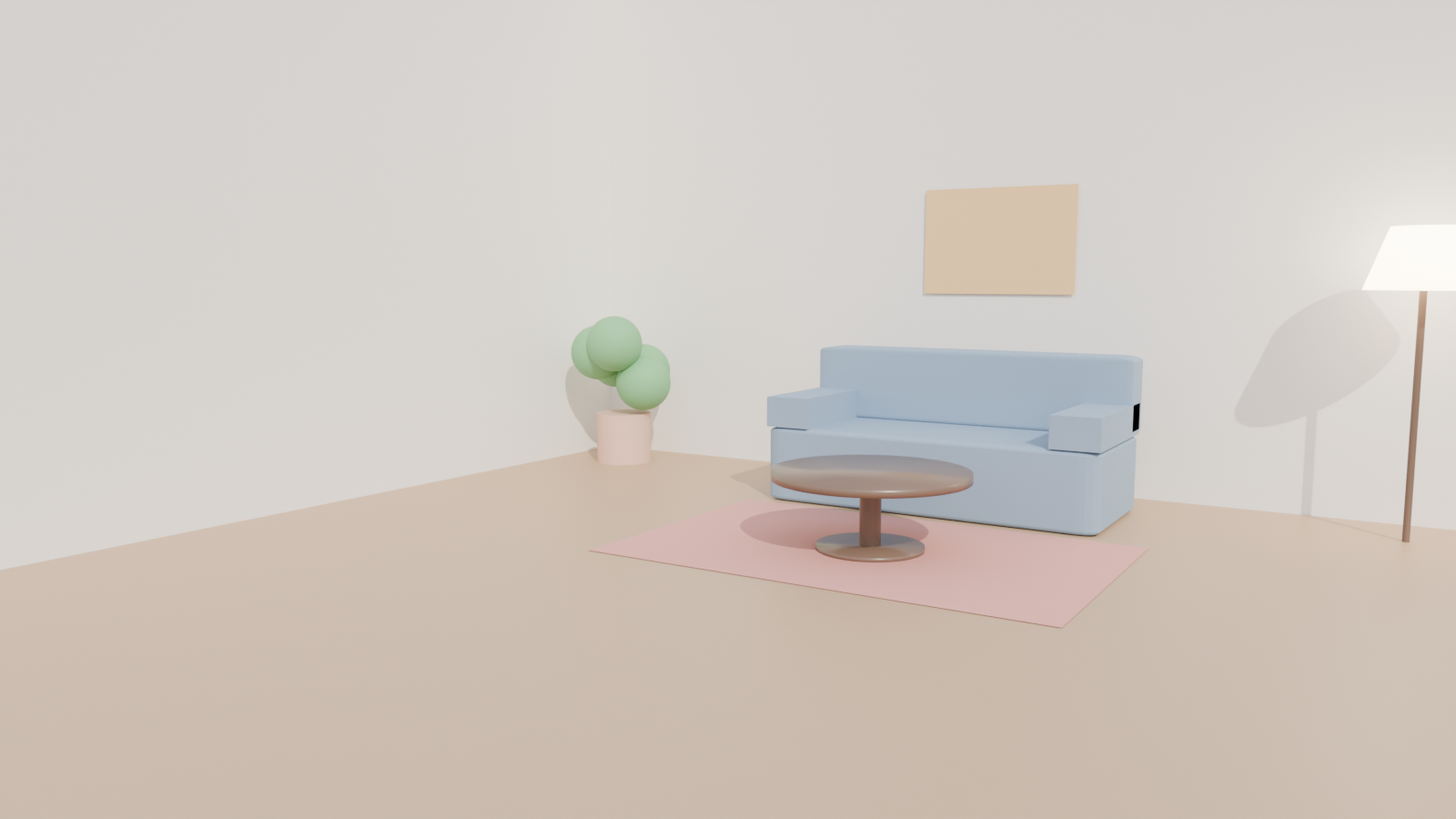
This living-room interior was rendered on a JANCTION GPU from a bpy script that uses only primitives. The overcast preset supplies soft ambient light and a sun lamp in the script casts the shadows through the open side of the room. It took 5.4 GPU seconds on the production GPU, 0.5 JPY at 0.1 JPY per GPU-second.
What is in the frame
A sofa, a low table, a rug, a lamp and a picture on the wall, all from cubes and cylinders. It is a layout study rather than a finished visualisation, which is exactly what an agent produces when someone describes a room in a sentence.
How the scene is built
Two light sources do the work. The overcast preset replaces the world with a soft sky, and a sun lamp defined in the script gives the hard shadows that make the furniture sit on the floor.
Adapt it
Ask your AI to move furniture, change the palette or open a window on another wall, and preview after each change. A preview is 1 to 4 frames at up to 720p and costs a few GPU seconds.
0.5 JPY for this render. The free welcome credit of a new key covers about 184 of them, with no card.
Render this example with your AI
ChatGPT · Claude · Grok · Perplexity
Use JANCTION Render (MCP server https://render.janction.jp/mcp) to render this example: render_preview(scene_url="https://render.janction.jp/samples/ex04_interior_room.py"). Then suggest how to change the colors, shapes and camera for my own subject. Ask me before the final render.
Each link opens the app with the text below filled in (if it is not, copy and paste it). If JANCTION Render is not connected in that app yet, add https://render.janction.jp/mcp as a connector first.
Blender warnings
- environment preset 'overcast' replaced the scene's world (HDRI lighting)
The script (bpy, runs as is)
ex04_interior_room.py. It builds the scene, the camera and the frame range; resolution, samples, denoising and the GPU are set by the service.
"""JANCTION Render example 04: a small living room built from primitives, sun through the open side (one still).

Reproduce: render_final(scene_url="https://render.janction.jp/samples/ex04_interior_room.py",
                        width=1600, height=900, samples=128, environment="overcast")
The overcast preset gives the soft ambient light; the sun lamp in the script gives the shadows.
"""
import math

import bpy
from mathutils import Vector

for ob in list(bpy.data.objects):
    bpy.data.objects.remove(ob, do_unlink=True)
scene = bpy.context.scene
scene.frame_start = 1
scene.frame_end = 1


def material(name, color, roughness=0.5, metallic=0.0, **inputs):
    mat = bpy.data.materials.new(name)
    mat.use_nodes = True
    bsdf = mat.node_tree.nodes["Principled BSDF"]
    bsdf.inputs["Base Color"].default_value = (*color, 1.0)
    bsdf.inputs["Roughness"].default_value = roughness
    bsdf.inputs["Metallic"].default_value = metallic
    for key, value in inputs.items():
        bsdf.inputs[key].default_value = value
    return mat


def smooth(ob):
    for p in ob.data.polygons:
        p.use_smooth = True
    return ob


def add(op, name, mat=None, **kw):
    getattr(bpy.ops.mesh, op)(**kw)
    ob = bpy.context.object
    ob.name = name
    if mat is not None:
        ob.data.materials.append(mat)
    return ob


def look_at(ob, target):
    ob.rotation_euler = (Vector(target) - ob.location).to_track_quat("-Z", "Y").to_euler()


def camera(location, target, lens=50.0):
    data = bpy.data.cameras.new("Camera")
    data.lens = lens
    cam = bpy.data.objects.new("Camera", data)
    scene.collection.objects.link(cam)
    cam.location = location
    look_at(cam, target)
    scene.camera = cam
    return cam


def light(name, kind, location, energy, target=None, size=1.0, color=(1.0, 1.0, 1.0)):
    data = bpy.data.lights.new(name, kind)
    data.energy = energy
    data.color = color
    if kind == "AREA":
        data.size = size
    ob = bpy.data.objects.new(name, data)
    scene.collection.objects.link(ob)
    ob.location = location
    if target is not None:
        look_at(ob, target)
    return ob


wall = material("Wall", (0.9, 0.87, 0.82), roughness=0.85)
wood = material("Wood", (0.52, 0.34, 0.2), roughness=0.45)
fabric = material("Fabric", (0.24, 0.34, 0.46), roughness=0.95)
rug = material("Rug", (0.68, 0.3, 0.26), roughness=1.0)
table = material("Table", (0.16, 0.1, 0.07), roughness=0.3)
leaf = material("Leaf", (0.18, 0.45, 0.2), roughness=0.7)
pot = material("Pot", (0.7, 0.45, 0.35), roughness=0.8)
lamp = material("Lamp", (1.0, 0.9, 0.75), roughness=0.5,
                **{"Emission Color": (1.0, 0.85, 0.6, 1.0), "Emission Strength": 12.0})
art = material("Art", (0.85, 0.55, 0.25), roughness=0.9)

add("primitive_plane_add", "Floor", wood, size=7)
back = add("primitive_plane_add", "BackWall", wall, size=7, location=(0, 3.5, 2.1))
back.rotation_euler = (math.pi / 2, 0, 0)
back.scale = (1, 0.6, 1)
left = add("primitive_plane_add", "LeftWall", wall, size=7, location=(-3.5, 0, 2.1))
left.rotation_euler = (math.pi / 2, 0, math.pi / 2)
left.scale = (1, 0.6, 1)

seat = add("primitive_cube_add", "SofaSeat", fabric, size=1, location=(0.0, 2.6, 0.25))
seat.scale = (2.2, 0.95, 0.5)
backrest = add("primitive_cube_add", "SofaBack", fabric, size=1, location=(0.0, 3.0, 0.75))
backrest.scale = (2.2, 0.25, 0.5)
for x in (-0.95, 0.95):
    arm = add("primitive_cube_add", "SofaArm", fabric, size=1, location=(x, 2.6, 0.6))
    arm.scale = (0.3, 0.95, 0.2)
for ob in (seat, backrest):
    m = ob.modifiers.new("Bevel", "BEVEL")
    m.width = 0.06
    m.segments = 4
carpet = add("primitive_plane_add", "Rug", rug, size=1, location=(0.1, 1.2, 0.004))
carpet.scale = (2.6, 1.7, 1)
top = add("primitive_cylinder_add", "TableTop", table, radius=0.55, depth=0.05, vertices=96, location=(0.1, 1.2, 0.42))
smooth(top)
add("primitive_cylinder_add", "TableLeg", table, radius=0.06, depth=0.4, vertices=32, location=(0.1, 1.2, 0.2))
foot = add("primitive_cylinder_add", "TableFoot", table, radius=0.3, depth=0.03, vertices=64, location=(0.1, 1.2, 0.015))
smooth(foot)
add("primitive_cylinder_add", "Pot", pot, radius=0.22, depth=0.4, vertices=48, location=(-2.9, 2.9, 0.2))
for i in range(5):
    a = i * 2 * math.pi / 5
    puff = add("primitive_uv_sphere_add", "Leaf", leaf, radius=0.22, segments=32, ring_count=16,
               location=(-2.9 + 0.2 * math.cos(a), 2.9 + 0.2 * math.sin(a), 0.65 + 0.08 * i))
    smooth(puff)
add("primitive_cylinder_add", "LampPole", table, radius=0.02, depth=1.5, vertices=24, location=(2.6, 3.0, 0.75))
shade = add("primitive_cone_add", "LampShade", lamp, vertices=48, radius1=0.3, radius2=0.18, depth=0.35,
            location=(2.6, 3.0, 1.6))
smooth(shade)
picture = add("primitive_plane_add", "Picture", art, size=1, location=(0.0, 3.48, 1.75))
picture.rotation_euler = (math.pi / 2, 0, 0)
picture.scale = (1.1, 0.75, 1)

light("Sun", "SUN", (4.0, -3.0, 5.0), 4.0, target=(-1.0, 1.5, 0.0), color=(1.0, 0.95, 0.85))
camera((2.7, -4.4, 1.5), (-0.7, 1.0, 0.75), lens=28)